Skip to content

Crossbar with a multipoint lock: is it useful for your Berlin door?

Considering a crossbar with a multipoint lock in Berlin? Start with your security objective, the existing door assembly and how the household uses it.
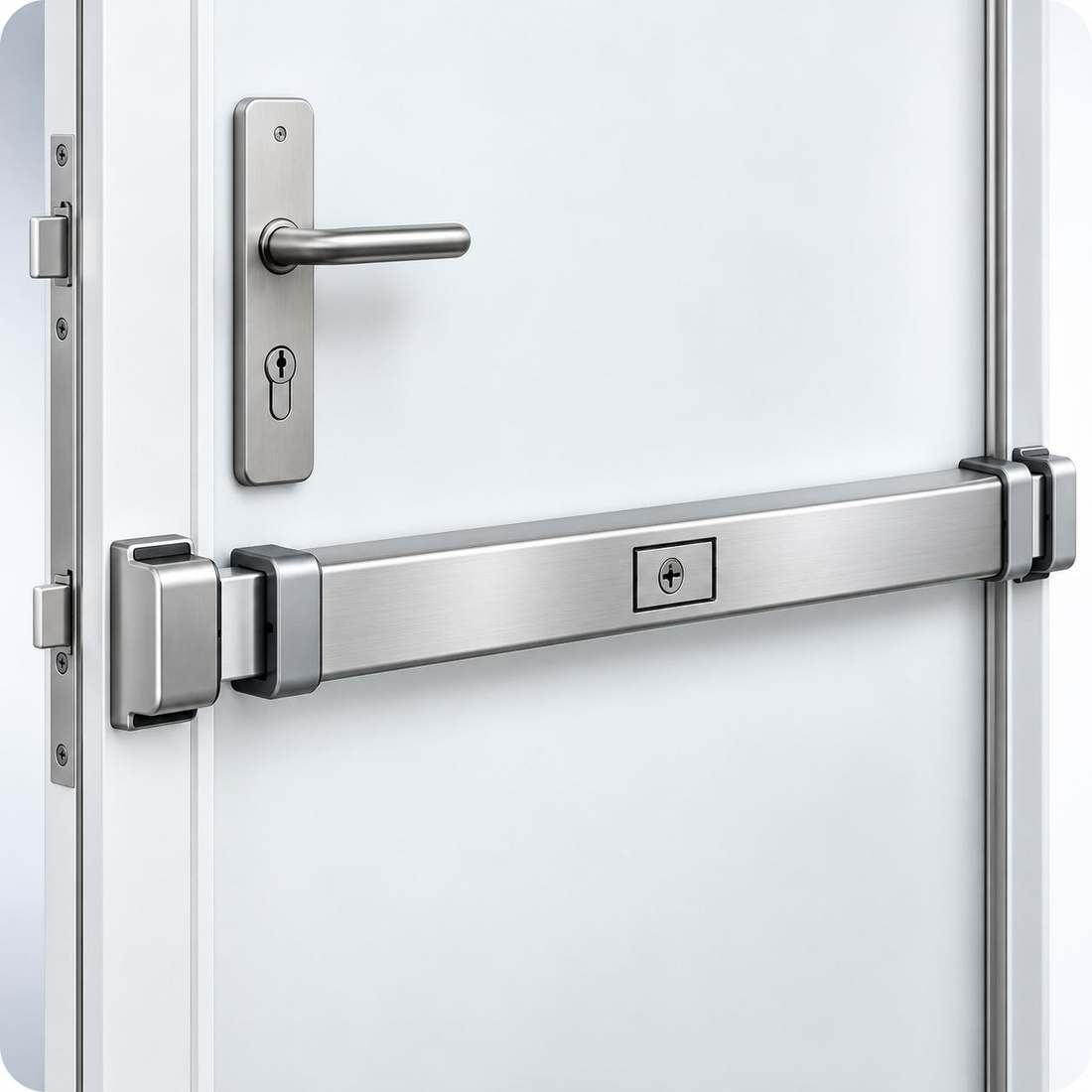
Security crossbar across a white door below the handle
Illustration from the A&J media library.

Contents
  1. Crossbar with a multipoint lock: what do you want to achieve?
  2. Identify an existing fault first
  3. Assessing a crossbar with a multipoint lock
  4. Daily use of a crossbar with a multipoint lock
  5. Which quotes are comparable?
  6. Crossbar with a multipoint lock before a planned door replacement

Crossbar with a multipoint lock: what do you want to achieve?

Your Berlin flat door locks at several points, yet you are considering an additional crossbar. Start the consultation with the reason. Do you want a separately operated lock, are you concerned about a specific weakness or does the existing mechanism no longer work reliably? Each answer leads to a different brief.

The number of visible locking points alone does not establish how suitable the whole entrance is. The door leaf, frame, fittings and their operation work together. A second product may make sense if it suits the objective and construction. It may also cost more and add an extra step without delivering the improvement you wanted.

In this reel A&J describes correcting an existing crossbar and adjusting its keeper. · Watch the video on Instagram

Another A&J post on Instagram

A&J introduces its crossbar installation service for Berlin homes. · Watch the video on Instagram

Identify an existing fault first

If the door is difficult to lock or occasionally sticks, describe that symptom when enquiring. An extra bar cannot explain why the main mechanism catches. First establish whether the existing system needs repair. You can then compare a functioning door with the proposed addition and keep the two expenses distinct.

The situation differs when the existing door works reliably and you deliberately want a separate locking action during longer absences. Involve the people who use the entrance every day. Establish who would hold both keys when needed and whether everyone expected to use the additional hardware can operate it.

Assessing a crossbar with a multipoint lock

The installer needs to assess the door as an assembly. In addition to available space on the leaf, the frame, existing fittings and use of the passage matter. Where the door carries a special rating or a manufacturer's guarantee, establish which retrofits are specified for that particular assembly. A working individual component cannot establish that the whole combination is suitable.

Daily use of a crossbar with a multipoint lock

Picture an ordinary weekday. One person leaves early, another remains inside and someone with an authorised key returns later. Discuss what state the entrance could be in at each point and how residents recognise the agreed arrangement. A simple routine people actually follow is worth more in daily life than an extra lock whose key nobody can find.

Which quotes are comparable?

Ask for separate descriptions of the existing-door assessment and the optional retrofit. Have the product, accessories, installation and combined functional check identified. Ask which of your original concerns the proposal actually addresses. If you mainly want an independent starting point for a burglary-prevention discussion, consult the guidance published by Berlin Police.

Crossbar with a multipoint lock before a planned door replacement

If the flat door is already due for replacement next year, raise the planned date during the consultation. A short-term retrofit is a different investment from a long-term addition. Ask the future door supplier what features are already specified. Have any potential reuse of a secondary bar confirmed only for the actual new door that has been assessed.

If you defer the decision, establish the door's condition today. Ask the quote to distinguish an identified fault, an optional improvement and anything still unknown. That helps you decide what needs attention now and what can reasonably be coordinated with the future replacement.

Decision guide

Situation Next step
The existing mechanism sticks First assess its condition and any repair needed.
A separate lock is wanted Agree who uses it, who holds keys and when it is needed.
Suitability of the door is unclear Agree an assessment before committing to a product.

Further guidance: Berlin Police – guidance on securing doors (PDF) (German)
Related services and guides

Contact A&J Locksmith Berlin · 030 61637725

Crossbar for double doors in Berlin: what needs checking?

Considering a crossbar for double doors in Berlin? Identify how each leaf is used, when the full opening is needed and what the installer must check.

Security crossbar across a white door below the handle
Illustration from the A&J media library.

Contents
  1. Crossbar for double doors: which leaf is normally used?
  2. Active leaf, inactive leaf or fixed panel?
  3. What the installer needs to see on site
  4. Reading a quote for a crossbar for double doors
  5. Handing over a crossbar for double doors
  6. Crossbar for double doors that open fully only occasionally

Crossbar for double doors: which leaf is normally used?

From outside, a double-leaf entrance can look like an unusually wide door. For an assessment, it matters whether both sections move or one is a fixed side panel. Tell your Berlin locksmith which leaf people normally use and when the second is opened. Only then is it clear what the retrofit needs to preserve.

A security crossbar can provide additional protection on a suitable door. Whether a particular product is suitable and approved for a double-leaf entrance depends on the door, frame and configuration specified by its manufacturer. An overall width in a catalogue cannot tell you where a suitable receiving fitting could be located.

A&J introduces its work on key systems, additional locks and security crossbars. · Watch the video on Instagram

Another A&J post on Instagram

A&J introduces its crossbar installation service for Berlin homes. · Watch the video on Instagram

Active leaf, inactive leaf or fixed panel?

The leaf used every day is often called the active leaf. The other movable part is the inactive leaf. Ordinary language works just as well: “We enter on the right every day and open the left side for wide items.” Describe a fixed glazed panel as immovable. For an initial enquiry, clear observation matters more than terminology.

For a rented or shared entrance, find out who can speak for the whole door. Another resident may routinely use the second leaf for a mobility aid, deliveries or a bulky bicycle. Their needs may be decisive even if you only open it once a year. Arrange the assessment so those requirements are known before choosing equipment.

What the installer needs to see on site

Describe the interior view, opening direction and normal sequence of operation. Without removing anything, show which controls are normally used to open the second leaf. Mention any markings indicating a special door function. Where escape-route or fire requirements apply, have the responsible party assess the proposed alteration.

Reading a quote for a crossbar for double doors

Have the quote specify which leaf the proposal covers and what should remain possible with the second leaf closed and open. Ask whether any required accessories and a functional check of both leaves are included. If only a survey is booked so far, the quote should show that no product decision has been made yet.

Handing over a crossbar for double doors

Rehearse two ordinary uses: a person enters through the active leaf, then the full width is required for the purpose you discussed. Ask for the finished setup to be demonstrated in both cases. Record who holds the secondary lock key and where other authorised users can find the operating instructions.

Crossbar for double doors that open fully only occasionally

The second leaf might only be opened for a large delivery. That makes it easy to overlook the person responsible during a brief survey. Ask who last needed the full width, whether a key was needed and where the operating instructions are kept. If the caretaker knows the routine, arrange their attendance at the survey or get their account in writing ahead of time.

Include a plain requirement for handover: “The full opening must remain available for the agreed use.” Describe the actual purpose, such as passing a trolley, rather than inserting an unverified measurement. The provider can then explain what information or approvals are still needed before offering a particular system.

Decision guide

Situation Next step
Second leaf also opens Include both intended uses in the enquiry.
Panel beside the door is fixed Describe it explicitly as a fixed panel.
Shared entrance has a special function Establish responsibility and requirements before the quote.

Further guidance: Berlin Police – guidance on securing doors (PDF) (German)
Related services and guides

Contact A&J Locksmith Berlin · 030 61637725

Removed door lock in Berlin: what happens to the old parts?

Will you need the removed door lock after a change in Berlin? Agree what will be returned, recorded or disposed of before the work begins.

Door handle and lock on a door leaf
Illustration from the A&J media library.

Contents
  1. Removed door lock: what should be handed back?
  2. Who can accept the removed door lock?
  3. Keeping a removed door lock for a later query
  4. Check old keys before discarding them
  5. A handover note that still makes sense later
  6. Removed door lock ahead of a second appointment

Removed door lock: what should be handed back?

The replacement works, the invoice is ready and only as the locksmith is leaving do you remember that management wanted to see the old part. Agree what should be returned before work starts. Identify whether you mean the lock inside the door, the key cylinder, the fittings or the old keys. People commonly use “lock” for several of these different things.

A removed door lock may be needed for comparison with a quote, consultation with the owner or a later technical assessment. The purpose determines the record worth keeping. A handover note may be enough for one household. Another may need the actual component for an examination that has already been arranged.

A&J on door opening, lock replacement and repairs in Berlin. · Watch the video on Instagram

Who can accept the removed door lock?

Have the person authorising replacement clarify the return as well. The owner, resident and person paying the bill may be different people. Someone simply meeting the locksmith may not know about an existing agreement for an old component. Record a name and callback number before the visit begins.

Suppose management booked the work, a tenant lets the locksmith in and the supplier wants to examine the cylinder being replaced. Establish who receives the component and for what purpose. A brief confirmation prevents the same part being promised to the supplier and resident at the same time.

Keeping a removed door lock for a later query

Record the date, the door concerned and the symptom seen before removal. A factual description such as “the key turned but the door stayed closed” is enough. It remains valid even if the cause has yet to be established. If a professional assessment is planned, avoid taking the old part apart yourself.

If a business takes the part away, ask why and request a receipt. Agree who will receive the findings. An invoice listing only the replacement often says nothing about where the old item went. An extra line in the record can spare several follow-up calls.

Check old keys before discarding them

In a shared key system, the same key may still operate building, cellar or side-room doors after the change. Use existing records to establish its function. Do not leave old keys and cylinders openly labelled with a full home address. Keep old and new keys separate at handover until you know which set remains in daily use.

A handover note that still makes sense later

For example, note one cylinder returned to the named person, one faulty lock retained for the agreed inspection and three new keys issued to the resident. Add the date and contact. Checking the replacement at the door remains a separate part of the visit. You can then trace both today's function and the whereabouts of the original parts.

Removed door lock ahead of a second appointment

If today's work is only temporary, the old assembly may still be needed at the next visit. Agree who keeps it until then and who brings it back to the door. If a different locksmith attends next week, they should be able to find that note in the booking record. A conversation in the stairwell is easy to lose.

Store the papers and parts separately from spare keys in everyday use. An unmarked box of different old components gives the next provider little help. A private note with the date and room name is often enough to prevent a mix-up between two doors in the same flat.

Decision guide

Situation Next step
Old part needed for assessment Record the recipient and purpose before removal.
Management books and resident attends Confirm return instructions ahead of the visit.
Old key still serves shared doors Confirm its continued use with the key administrator.

Further guidance: Consumer advice on contracting a tradesperson (German)

Related services and guides

Contact A&J Locksmith Berlin · 030 61637725

Locksmith price change at 8 pm in Berlin: which quote applies?

Calling near a locksmith price change in Berlin? Agree the total before dispatch if the call and arrival fall into different published price periods.

Smartphone with an on-screen keyboard
Karl432 · CC0 1.0 · Resized

Contents
  1. Calling just before a locksmith price change
  2. Reading the published A&J prices
  3. Confirm the quote around a locksmith price change
  4. A delayed arrival at a locksmith price change
  5. Who will check the invoice at the door?
  6. Comparing offers around a locksmith price change

Calling just before a locksmith price change

You are outside a flat in Berlin at 7.50 pm. The provider lists a different price from 8 pm and says someone will arrive later. Which price applies? Published time bands are the starting point. For your booking, ask explicitly which point in time determines the quote and what total the provider confirms for your particular door.

The enquiry, booking, arrival and start of work can all happen at different times that evening. “We'll be there around eight” does not identify a price. Ask about the time rule before booking where possible. That gives the provider a chance to clarify while you can still decide whether the offer works for you.

A&J on door opening, lock replacement and repairs in Berlin. · Watch the video on Instagram

Reading the published A&J prices

For a door that has fallen shut, the A&J price list gives an opening fee of €49 during the 7 am to 8 pm period. The 8 pm to midnight band lists €69. Published travel charges are €29 to €39. For that basic situation, the figures add up to €78–88 during the day or €98–108 in the evening, before any additional work.

That calculation does not confirm a price for a 7.50 pm booking. The table also distinguishes between a door that fell shut and one locked with a key. Explain what you did when leaving the flat. If you turned the key in the lock, comparing the quote with the lower line for a door that simply closed could mislead you.

Current A&J price list

Confirm the quote around a locksmith price change

A short question is enough. “My flat door only fell shut. You expect to arrive after 8 pm. What total including travel can you confirm for this opening at my address? Does it change if you arrive later?” Note the reply and who gave it. If the provider can only give an estimate, ask which condition is still unknown.

A delayed arrival at a locksmith price change

If arrival before the change had been agreed and the provider now calls about a delay, refer back to the price agreement. Ask whether that amount still stands or a different one is being proposed. Record the answer before authorising further work. A late arrival and an additional locking point discovered at the door are separate circumstances.

Who will check the invoice at the door?

If a relative books remotely, send the person at the door the confirmed total and the description used for the quote. They can then ask a specific question if the total differs. Compare the work, travel and any separately agreed extras. Asking about one line item is generally easier to resolve than a broad disagreement about evening rates.

Comparing offers around a locksmith price change

At 7.55 pm, the first provider quotes only the opening charge and the second gives a total for the expected later arrival. Write the same four fields for both: door condition, applicable time, travel and confirmed total. A blank field is a question still to ask. The smaller initial number tells you little if travel or a surcharge is missing.

It can also matter whether someone can bring a spare soon. Confirm their actual arrival time, then tell the provider clearly whether you are booking or simply asking for information. That preserves a clear record of when a price enquiry became an actual job.

Decision guide

Situation Next step
Call before 8 pm, arrival afterwards Confirm the applicable total before booking.
Arrival delayed Refer to the original quote and clarify any change.
Different condition found on site Check the new scope and price before approving it.

Further guidance: Consumer advice on hiring a locksmith (German)

Related services and guides

Contact A&J Locksmith Berlin · 030 61637725

Crossbar spare parts in Berlin when the model is unknown

Looking for crossbar spare parts in Berlin? Document the maker, design and the keeper needed before ordering, especially when the model label is missing.

Security crossbar across a white door below the handle
Illustration from the A&J media library.

Contents
  1. A keeper is needed but the model is unknown
  2. First identify the job the part has to do
  3. What can help identify crossbar spare parts?
  4. If the maker cannot confirm compatibility
  5. Recording crossbar spare parts after delivery
  6. Crossbar spare parts for several similar doors

A keeper is needed but the model is unknown

Ordering crossbar spare parts sounds straightforward until two almost identical keepers sit side by side. The colour matches and the outline looks familiar, yet they may be different versions. Before an installer places an order, establish which system is fitted and which component is actually needed. A photograph of a similar flat door cannot establish that.

The A&J post here describes correcting an existing crossbar and its keeper plate. It does not give a part number. Use it to start the conversation if your query also concerns the receiving fitting at the frame. A successful adjustment on someone else's door is not approval to order a part for yours.

In this reel A&J describes correcting an existing crossbar and adjusting its keeper. · Watch the video on Instagram

First identify the job the part has to do

Point to the part you actually mean. Is the problem with the housing on the door, the key cylinder or the fitting beside the door? Is only a visible cover missing? Describe what is absent and whether the rest of the lock still operates in normal use. The everyday word “bar” can lead to several quite different questions over the phone.

If management wants a consistent appearance, record the colour preference separately. Model compatibility and function come first. A similar cover does not establish that the component underneath can be reused. If the initial assessment is based only on a picture, ask what still needs checking before a binding order is placed.

What can help identify crossbar spare parts?

An old invoice, operating instructions or handover record can tell you more than an isolated label. Look for the maker, model range and any stated version. Confirm the document actually belongs to this door. In a building fitted out in several phases, similar-looking locks may come from different deliveries.

If no paperwork exists, an overview of the inside and a picture of the affected keeper may be enough for the initial enquiry, where photography is authorised. Keep residents' names, key blades and other private information out of frame. Do not dismantle the unit for a photograph. An unresolved identification question can be added to the on-site assessment.

If the maker cannot confirm compatibility

Ask for distinct options in the quote: identification at a visit, procurement of a confirmed component or assessment of another suitable solution. Agree when additional costs start and who can authorise the next stage. An unsuccessful parts search should not unintentionally turn into an order for an entire replacement system.

Recording crossbar spare parts after delivery

Record the confirmed part description with the model, installation location and invoice date. The fitting should be checked on the existing door at handover. Give the record to whoever will book future repairs. With older equipment, that small step can prevent the whole identification process having to start again.

Crossbar spare parts for several similar doors

Two flats in one building appear to have the same bar. One has an invoice and the other does not. Before relying on its item number, check the installation period and which entrance it refers to with management. Tell the installer which information came from the other flat's document. They can use it as a lead without confusing it with a confirmed identification.

If several owners are ordering together, label each quote with its door. Check whether the price covers one keeper or a set, and whether it includes supply alone or fitting as well. Only with those details can two apparently similar prices be compared fairly.

Decision guide

Situation Next step
Unknown model Have the documents and visible markings reviewed.
Part looks similar Get compatibility confirmed for the actual version.
No confirmed replacement Authorise assessment and an alternative quote separately.

Further guidance: ABUS – product information for the PR2700 crossbar (German)

Related services and guides

Contact A&J Locksmith Berlin · 030 61637725

Security crossbar catches at the keeper? A Berlin repair example

Your security crossbar catches at the keeper? An A&J repair reel provides a starting point for describing the fault and agreeing what to check afterwards.

Security crossbar across a white door below the handle
Illustration from the A&J media library.

Contents
  1. The crossbar catches: a repair example from Berlin
  2. At what point does the crossbar catch?
  3. The crossbar catches: does the main lock still work?
  4. Agree inspection, adjustment and replacement separately
  5. Checking that the crossbar no longer catches
  6. When the security crossbar catches intermittently

The crossbar catches: a repair example from Berlin

A security crossbar is already installed, but its keeper no longer fits as intended. In the accompanying reel, A&J describes correcting an existing bar and adjusting the keeper plate. That raises a practical question for other flat entrances. What can you observe and report before anyone orders a replacement bar?

The short post gives neither the door's history nor the exact model. It cannot establish the right repair for every flat. It does illustrate why an assessment should include the fittings receiving the bar. Stiff closing on its own tells you little about which individual component, if any, needs replacing.

In this reel A&J describes correcting an existing crossbar and adjusting its keeper. · Watch the video on Instagram

At what point does the crossbar catch?

Describe the point you recognise from normal use. Does the flat door otherwise close as usual? Does the sound start only when you operate the additional lock? Does it seem to come from the left or right when viewed from inside? Those details help more than assuming the cylinder is defective. If movement is blocked, avoid further attempts using force.

Compare with the previous week. Did the problem develop gradually or become noticeable immediately after work on the flat entrance? If the door leaf was altered, pass on the timing as an observation. Report what you know without treating it as proof of an installation error or material failure.

The crossbar catches: does the main lock still work?

In some homes the main lock still works while the crossbar sticks. Elsewhere the bar may remain in a position that prevents normal use of the door altogether. Tell the provider whether people can enter and leave and whether the flat can be secured when empty. That makes a substantial difference to scheduling.

Agree inspection, adjustment and replacement separately

Ask for an initial assessment of the door, bar and receiving fittings working together. Find out what the first price covers. If adjustment is sufficient, the invoice should identify the work actually done. If replacement is proposed, have the provider identify the component and explain its function before you authorise it.

Checking that the crossbar no longer catches

At handover, ask for the normal operating sequence to be demonstrated, then operate the door yourself. Pay particular attention to the point where the rubbing used to occur. Note whether both the main lock and the secondary bar were checked and what to report if the symptom returns. The result should be understandable to the person using the entrance every day.

When the security crossbar catches intermittently

If the fault happens to disappear during the visit, bring a brief record of two or three ordinary uses. Note whether the main door was already latched, which side you operated the lock from and whether the crossbar reached its usual end position. A reliable description of one occurrence is more useful than repeatedly attempting to operate a blocked door.

You can describe urgency concretely: “The main lock secures the flat today, but I cannot operate the additional bar reliably.” If the bar instead prevents someone from entering or leaving, say that first. Two problems that sound similar mechanically may call for quite different responses in practice.

Decision guide

Situation Next step
Main lock works and bar rubs Describe the additional lock and current access separately.
Started after door work Have the date and nature of that work ready.
Adjustment proposed Agree scope, price and a functional check together.

Further guidance: ABUS – product information for the PR2700 crossbar (German)

Related services and guides

Contact A&J Locksmith Berlin · 030 61637725

A key system for two flats sharing one Berlin entrance

Plan a key system for two flats in Berlin. Give both households access to the common entrance while keeping their flat keys and private rooms separate.

Lock cylinder showing the keyway
Illustration from the A&J media library.

Contents
  1. A key system for two flats begins at the shared entrance
  2. A small table prevents a significant misunderstanding
  3. A key system for two flats with an existing front door
  4. Include occasional users in the discussion
  5. Handing over a key system for two flats
  6. Keeping a key system for two flats usable when one household moves

A key system for two flats begins at the shared entrance

Two households use the same entrance to a Berlin building. Upstairs, household A should be able to open only its own flat. Downstairs, the same should apply to household B. Both flat keys should operate the shared front door. Start the consultation with that requirement. Asking for “one key for everything” leaves open whose “everything” is meant.

Put both households' requirements side by side. First identify the private areas, then the common areas. Sharing a front entrance does not require neighbours to be able to enter one another's flats. Have the installer confirm whether and how that arrangement can be achieved with the existing cylinders and system.

A&J introduces its work on key systems, additional locks and security crossbars. · Watch the video on Instagram

A small table prevents a significant misunderstanding

List one door per row: front entrance, upstairs flat, downstairs flat, common bicycle room and private cellar. Give each household's keys a column. Write “yes”, “no” or “to be confirmed” in every cell. During ordering, a blank can easily be taken to mean approval or simply something someone forgot.

For example, both households use the cycle room, while the next cellar belongs to the upstairs flat only. Calling both spaces “basement” makes the order ambiguous. Use a name that uniquely identifies each door on site. Keep key numbers off publicly accessible plans. A private list of required functions is enough for requesting a quote.

A key system for two flats with an existing front door

If one household wants to replace a worn flat cylinder, the other household does not automatically need an entirely new setup. First ask whether a compatible replacement is available and who can authorise ordering. If the system is poorly documented, ask the provider to distinguish a temporary two-key arrangement from the intended final configuration.

Include occasional users in the discussion

A cleaner may only need the staircase. A relative may be allowed into the upstairs flat but not the downstairs one. Record these as separate roles instead of automatically granting a whole household's rights. If residents have yet to decide, mark the role as open. Whether expansion is possible later depends on the selected system.

Handing over a key system for two flats

Arrange a handover where both households receive their keys and can verify the agreed access at the relevant doors. Name a person responsible for future orders. Keep the key count, issue record and approved version of the door list together. If residents change later, this record helps determine which private and common components need attention.

Keeping a key system for two flats usable when one household moves

What happens when the upstairs household moves out and some issued keys are missing? That question may influence the design you choose today. Agree which keys are issued privately, who keeps a current issue list and how the shared front door will be treated during a changeover. The downstairs household should be able to understand whether a later change affects its keys.

Plan for the transition as well. If one flat is still being refurbished and several people need access, a separate temporary arrangement may make sense. Determine when the permanent keys will first be issued and who collects the earlier ones. A brief handover list often addresses that organisational question better than an extra cylinder in the first quote.

Decision guide

Situation Next step
Both flats use the entrance Grant shared access only at the intended doors.
One private cylinder is faulty Check system compatibility and ordering authority.
Others need access Define their role and the doors they need.

Further guidance: Schliessanlage.de – what a master key chart records (German)

Related services and guides

Contact A&J Locksmith Berlin · 030 61637725

Door lock with a restrictor: receiving visitors in Berlin

Considering a door lock with a restrictor in Berlin? Check how you receive visitors, use the inside controls and arrange access when assistance is due.

Door handle and lock on a door leaf
Illustration from the A&J media library.

Contents
  1. Door lock with a restrictor: what should change when someone calls?
  2. Operating positions of a door lock with a restrictor
  3. Using a door lock with a restrictor when visitors have keys
  4. What the installer needs to check at the entrance
  5. Try the routine yourself at handover
  6. A door lock with a restrictor for two different routines

Door lock with a restrictor: what should change when someone calls?

Someone rings. You want to speak to them without immediately swinging the flat door wide open. An additional door lock with a restrictor may suit this situation. On suitable models the restrictor limits how far the door opens. Whether that helps in your Berlin flat depends on how you receive visitors, who operates the door and from which side.

Before the consultation, write one typical sentence such as “I want to talk through the partly open door and then release it myself.” That is a different requirement from wanting an additional lock when leaving the flat empty. A model may offer functions for both purposes. Ask to see how the proposed unit is operated in each state.

A&J introduces its work on key systems, additional locks and security crossbars. · Watch the video on Instagram

Operating positions of a door lock with a restrictor

Discuss three positions: closed, partly open for conversation and fully released. Ask whether one person can move through the sequence without stepping aside or reaching over a parked walking aid. A demonstration unit may help more than a measurement of the opening width in centimetres.

A limited opening may be enough for conversation but too narrow to receive an item. Use a real example to explain whether you want to see and hear a visitor or accept a delivery. Follow your usual identity checks with unfamiliar callers. A mechanical opening limit tells you nothing about who is at your door.

Using a door lock with a restrictor when visitors have keys

A carer or family member may hold a flat key. Before buying, ask how an engaged inside restrictor affects access on this particular model. Include the answer at handover. Saying that someone has a key only describes their access once everyone also understands the state of the secondary lock.

What the installer needs to check at the entrance

A narrow frame, existing hardware or a nearby light switch can affect where a control makes sense. Show the installer the inside of the entrance and explain what alterations have been agreed. If the door has a special rating, refer suitability to the responsible party. A catalogue photograph alone cannot establish suitability for that entrance.

Try the routine yourself at handover

The resident should be able to operate each agreed position. Rehearse a normal visit together and have the installer point out how to recognise the fully released state. Also record the keys handed over and in which state an authorised visitor can enter independently. Future users will find that more useful than a model number alone.

A door lock with a restrictor for two different routines

One resident expects a scheduled delivery in the morning while a flatmate has friends round in the evening. One needs an inside control they can easily feel, the other needs space beside a coat rack. Ask each to describe how they move at the door. That can reveal whether the proposed controls are accessible to everyone or a sample needs another trial together before ordering.

Finally, agree what expected visitors need to know. For someone who needs access at a set time, a reliable ring-and-callback arrangement can matter as much as the model chosen. Keep contacts private rather than attaching operating instructions to the outside of the flat.

Decision guide

Situation Next step
Talking through a gap Ask for a demonstration of the restricted position.
Regular visitor holds a key Check access with the restrictor engaged for this model.
Several residents Rehearse the sequence with the people using it.

Further guidance: Berlin Police – guidance on securing doors (PDF) (German)
Related services and guides

Contact A&J Locksmith Berlin · 030 61637725

Lost master key in Berlin? How to report the affected doors

Lost master key in Berlin? Report the affected areas, last confirmed handover and current access before anyone orders a replacement cylinder.

A ring holding several different keys
Pittigrilli · CC BY-SA 4.0 · Resized

Contents
  1. Lost master key: what to report first
  2. Lost master key: when was the last confirmed handover?
  3. Lost master key while staff need access
  4. Separate the mechanical key, fob and badge
  5. If the set turns up again
  6. Lost master key during a contractor handover

Lost master key: what to report first

If a master key goes missing in a Berlin workplace, asking for every lock to be changed tells the administrator very little. They need the last confirmed possession, the known key group and a contact who can be reached. Report the loss promptly through the agreed internal channel. While the search continues, the key administrator can establish which areas might be affected.

Workplaces use “master key” loosely. A key for every door on one floor can differ from a key for several buildings. If you are unsure of its reach, say what you routinely used it for. Let the administrator confirm the assignment against the records. One example of normal use is not a complete account of its access rights.

A&J introduces its work on key systems, additional locks and security crossbars. · Watch the video on Instagram

Another A&J post on Instagram

A&J on lost keys, door opening and cylinder replacement in Berlin. · Watch the video on Instagram

Lost master key: when was the last confirmed handover?

Distinguish between using the key yourself, giving it to another person and assuming it was in a cupboard. Record the date, approximate time and anyone who can confirm a handover. Say whether it disappeared alone or with a labelled bag. Avoid posting photos of key blades, identifying numbers or lists of accessible rooms in large group chats.

At a shift change, a colleague may confirm accepting a bag without checking each item. Record that exactly as stated. It avoids assigning blame and helps identify where the contents were last actually checked. Ask for a reference number to use if the key or further information turns up later.

Lost master key while staff need access

Reporting the missing key and getting through a particular locked door have different purposes. If staff need one room today, identify that door and the person who can authorise entry. A locksmith can then understand the immediate scope. The person responsible for the system should establish the wider impact before deciding on changes to several cylinders.

Separate the mechanical key, fob and badge

If a digital badge was on the same ring, report both items separately. The administrator can check the available procedures for the electronic credential. The mechanical key needs its own assessment of the locks affected. Record which item each response refers to, especially where reception, IT and facilities staff are handling separate reports.

If the set turns up again

Notify the same contact and ask where the set should be returned. A replacement may already have been issued or temporary access agreed for certain areas. Record the place of recovery and time of return before the key re-enters circulation. The next shift then has an accurate record and need not keep searching for an item already handed back.

Lost master key during a contractor handover

With an external cleaning contractor, issue and return may go through two different people. Reception logs the issue and a shift supervisor collects the keys later. Ask both about their own records. A morning signature cannot confirm an evening return. Likewise, “job completed” does not establish that the key was returned to the agreed place.

If the next shift is due, assign someone to coordinate the search and someone else to arrange access today. Set a time to compare updates. That keeps the report manageable even when the original recipient cannot be reached. Close the case against a documented return or a decision by the key administrator.

Decision guide

Situation Next step
Unknown key group Report the last use and have the assignment checked.
One room is needed today Identify the authorised person and specific door.
Key found after replacement ordered Update the case and reconcile issued keys.

Further guidance: Schliessanlage.de – what a master key chart records (German)

Related services and guides

Contact A&J Locksmith Berlin · 030 61637725

Only flat key lost in Berlin? Plan for the next time you leave

Only flat key lost in Berlin? Before booking an opening, work out how you will secure the flat and get back in when you next leave.

A ring holding several different keys
Pittigrilli · CC BY-SA 4.0 · Resized

Contents
  1. Only flat key lost: two decisions before the call
  2. Only flat key lost, but a spare is inside
  3. When the lost key also opened the main entrance
  4. How long can you stay today?
  5. What to record before the locksmith leaves
  6. Only flat key lost and the flat is in a rear building

Only flat key lost: two decisions before the call

The door is open, the locksmith is packing up and you need to leave for work in an hour. How will you lock up? If you have lost your only flat key, raise that second situation when booking. Opening the door gets you back inside. Whether you can lock up and return by yourself depends on the keys and the lock you will have afterwards.

There is a difference between your only key and the only key in existence. A relative may have one but only be able to bring it that evening. A spare might even be inside your flat. Either answer can change the job. What matters is whether the spare fits that particular door and when you can actually have it in your hand.

A&J on door opening, lock replacement and repairs in Berlin. · Watch the video on Instagram

Another A&J post on Instagram

A&J on lost keys, door opening and cylinder replacement in Berlin. · Watch the video on Instagram

Only flat key lost, but a spare is inside

If you know there is a spare in a drawer, an opening alone may be sufficient for now. Explain whether the door simply fell shut or whether you locked it when leaving. Before the locksmith departs, allow time to find the spare and check normal operation together. A vague memory of “some key in the hallway” is too uncertain to plan around.

If the spare cannot be found, pause. Ask whether a second job would help, whether a suitable part is available and what it would cost. Authorising the opening has not settled those questions. In a rented flat, establish who needs to be consulted about the existing locking system.

When the lost key also opened the main entrance

Some residents use the same key for the building entrance and their flat. A replacement cylinder in the flat does not change the common entrance. Tell management which shared doors the missing key used to open. Separately, establish how you will enter the building next time you come home. Otherwise your new flat key may be of little use when you reach the street door.

How long can you stay today?

Suppose the opening is at noon, your shift starts at one and the spare arrives at six. In that schedule, someone bringing a key later does not let you lock up now. An authorised flatmate may be able to take over. Agree who will arrive, which door they can operate and who can be contacted if additional work needs approval.

What to record before the locksmith leaves

Note whether a cylinder was replaced, how many new keys were handed over and which old keys still serve other doors. Keep the new ones separate at first. If the missing key could be connected to your address, discuss that fact separately from having the door open again. Finding a spare only settles the immediate question of access.

Only flat key lost and the flat is in a rear building

Walk through your next arrival in your mind, starting from the street. In a Berlin rear building the gate, stairwell and flat may have three separate locks. If the spare only opens the flat while the relative bringing it is waiting at the courtyard gate, having a key still does not provide a complete route inside. Write down who can legitimately operate each door today.

When contacting management, a clear description of the location matters more than a key number in a message. “Separate access to the courtyard and the private flat” describes the problem without circulating internal system details.

Decision guide

Situation Next step
Spare inside the flat Arrange an opening and check the spare before the visit ends.
Spare due after work starts Arrange a handover or a secure interim plan.
One key served two entrances Arrange future access to the building with management.

Further guidance: Consumer advice on contracting a tradesperson (German)

Related services and guides

Contact A&J Locksmith Berlin · 030 61637725